
Software delivery has never moved faster. Release cycles are compressing. Applications are growing more complex. And QA teams are expected to deliver broader test coverage with the same (or fewer) resources than before.
The result? Performance issues discovered late. Fragmented tooling across teams. Manual overhead that slows every sprint. For organizations under pressure to increase release velocity without sacrificing quality, traditional testing workflows are no longer sufficient.
Perforce Autonomous Testing represents a fundamentally different approach: AI-driven test orchestration that brings functional and performance testing together in a single, unified workflow. At its core is Perforce BlazeMeter, the enterprise continuous testing platform that shifts performance validation left, reduces manual overhead, and delivers the unified visibility teams need to release with confidence.
Paired with Perforce Perfecto’s advanced web, mobile, and desktop testing capabilities, software testing and QA have taken a significant leap forward.
Back to top
4 Reasons Why Traditional Testing Workflows Are Breaking Down
Before examining how Perforce BlazeMeter powers autonomous testing, it helps to understand the four obstacles most QA teams are actively navigating.
Testing Can't Keep Pace With Release Velocity
More applications, more APIs, more services. AI has dramatically increased scripting velocity, but can you trust them? All of these require validation across shorter release windows. AI-driven software delivery puts pressure on QA processes that were designed for a slower era.
Fragmented Testing Creates Blind Spots
Functional and performance testing frequently exist in entirely separate workflows and are managed by different teams using different tools. The result is disconnected reporting, collaboration challenges, and gaps in release confidence.
Performance Testing Happens Too Late
When performance issues surface post-sprint, they create costly bottlenecks. Teams spend more time on rework than on prevention, and late-stage defects consistently delay releases.
Manual Setup Slows Innovation
Environment configuration, test scheduling, device management, and test maintenance all add significant overhead. The cumulative burden limits testing capacity and diverts skilled engineers away from higher-value work.
Back to topWhat Is Perforce Autonomous Testing?
Perforce Autonomous Testing is a unified, AI-driven testing platform built on a new testing model: describe → execute → analyze.
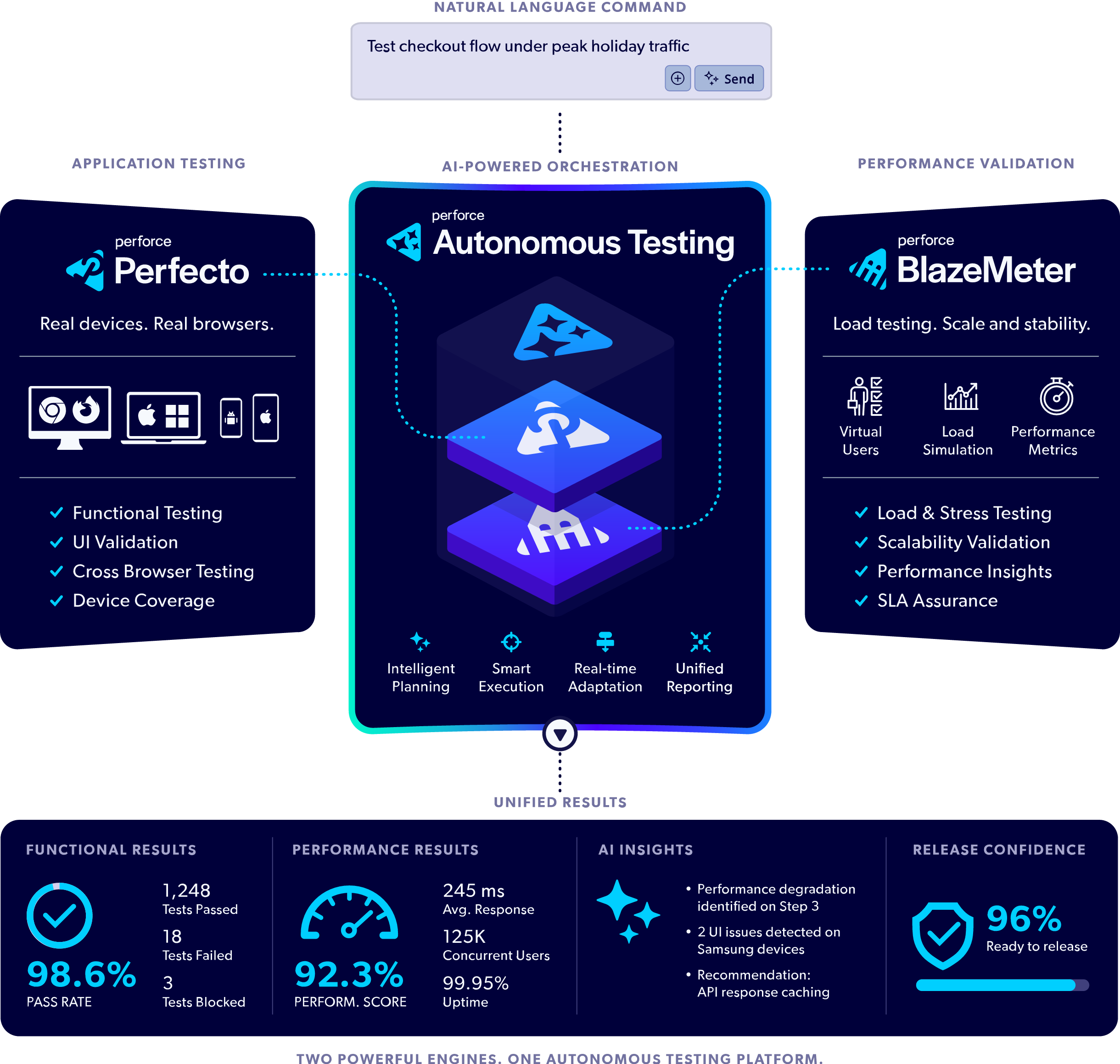
Rather than relying on scripting expertise or manual orchestration, teams define tests using plain-language prompts through an AI chat interface. The platform then automatically configures environments, orchestrates execution across testing workflows, and generates unified results to combine functional and performance insights in a single view.
Key capabilities of the Perforce Autonomous Testing model include:
- AI-powered test creation: Natural-language test definitions reduce scripting dependency and expand testing access beyond specialist roles.
- Unified test orchestration: Policy-based execution rules coordinate automated workflows across testing types.
- Centralized reporting: Combined functional and performance results support faster, more confident go/no-go release decisions.
This approach is designed for modern enterprise teams; not just QA engineers, but agile testers, business analysts, product teams, and DevOps leaders who need quality visibility without the traditional barriers to entry.
Back to topHow BlazeMeter Powers Perforce Autonomous Testing
Perforce BlazeMeter provides the intelligent performance and functional testing engine that makes Perforce Autonomous Testing work in practice.
Bringing Functional and Performance Testing Together
One of the most significant limitations of traditional testing is the separation of functional and performance workflows. By combining the power of BlazeMeter and Perfecto, Perforce Autonomous Testing resolves this by enabling both validation types to execute from a single test scenario. This reduces duplicated effort, improves collaboration between QA and engineering teams, and ensures performance is validated alongside functionality rather than after it.
Shift-Left Performance Testing
BlazeMeter enables in-sprint performance validation. That means shifting what was traditionally a late-stage activity into earlier phases of development. By identifying bottlenecks before code reaches staging, teams eliminate the costly rework that comes from late-discovered defects.
According to BlazeMeter customer data, organizations that adopt shift-left performance testing in CI achieve up to 30% faster release cycles and catch 40% more regressions pre-release.
“What took us 6 to 8 hours, on [Perforce Autonomous Testing] now takes 15 minutes...”
Chris Trimper, Enterprise QA Sr. Solution Architect, Independent Health
AI-Driven Test Creation and Execution
Within the Perforce Autonomous Testing workflow, BlazeMeter contributes AI-powered capabilities that reduce administrative overhead at every stage:
- Natural-language test definitions eliminate the need for manual scripting.
- Automated environment setup removes configuration delays.
- AI log analysis and anomaly detection surface real bottlenecks (not test noise) to reduce mean time to resolution by as much as 87.5%, based on BlazeMeter customer outcomes.
Unified Reporting Across Teams
BlazeMeter combines functional and performance insights into a centralized reporting view to create a shared source of truth for QA, DevOps, and engineering leaders. This unified visibility supports faster release decisions and reduces the coordination overhead that comes with maintaining separate reporting pipelines.
Back to topKey Benefits for Engineering and QA Leaders
For QA directors, performance engineers, and DevOps leaders evaluating AI-driven testing platforms, the practical outcomes of Perforce Autonomous Testing powered by BlazeMeter fall into four categories:
- Scale testing without scaling headcount. AI-assisted workflows increase test coverage and reduce dependency on specialized resources, improving team efficiency without proportional increases in cost.
- Move faster without increasing risk. Earlier performance feedback, faster defect detection, and reduced release delays give teams the confidence to ship at speed.
Enterprise-grade traceability and governance. Through policy-based execution, validation rules, and unified reporting, gain end-to-end visibility across testing activities, consistent enforcement of quality standards, and a governed approach to AI-driven testing that supports compliance, accountability, and release confidence.
- Consolidate fragmented testing processes. A unified platform improves collaboration across QA, DevOps, and product teams, reduces operational complexity, and supports a coherent quality strategy across the organization.
What Makes Perforce Autonomous Testing Different?
The distinction between Perforce Autonomous Testing and conventional automation is not simply the addition of AI features. It is a fundamental change in how testing is orchestrated.
A single natural-language scenario drives multiple validation types (functional and performance) simultaneously. Repetitive administrative tasks are eliminated through intelligent workflow automation. And testing participation expands beyond specialists to include agile testers, business analysts, and product teams who previously lacked the scripting expertise to contribute.
This combination of accessibility, orchestration, and AI-powered execution creates measurable value for organizations pursuing AI adoption in software delivery, and provides the foundation for increasingly autonomous testing workflows over time.
Back to topExtending Autonomous Testing With Perfecto
BlazeMeter handles intelligent performance validation. Perforce Perfecto extends that coverage across web, mobile, desktop, and visual testing to complete the end-to-end validation picture.
Back to topAI-Powered Desktop Testing
Perfecto enables automated testing of native desktop applications without relying on brittle scripts or object locators. For enterprises with complex legacy applications or non-standard environments, this capability closes a gap that traditional automation tools cannot address.
Visual Validation and User Experience Testing
Perfecto detects UI changes across releases and verifies visual consistency alongside functional behavior to improve confidence in customer-facing experiences where appearance and interaction are as critical as underlying function.
The Combined Value of BlazeMeter and Perfecto
BlazeMeter and Perfecto together, orchestrated through Perforce Autonomous Testing, deliver what neither platform provides independently. BlazeMeter contributes intelligent performance and functional validation. Perfecto extends coverage across web, mobile, desktop, and visual layers. Perforce Autonomous Testing orchestrates both into a unified workflow, creating a "1+1=3" benefit: greater testing coverage, reduced tool sprawl, and consolidated visibility from a single platform.
 Back to top
Who Should Consider Perforce Autonomous Testing?
Perforce Autonomous Testing is well-suited for organizations that:
- Hold existing Perforce BlazeMeter or Perfecto investments and want to extract greater value from those tools.
- Face tool sprawl across QA, DevOps, and engineering teams.
- Are under pressure to increase release velocity without increasing QA headcount.
- Are pursuing AI-driven transformation within their software delivery organization.
A Smarter Path to Continuous Quality
Perforce BlazeMeter serves as the engine for intelligent, AI-driven testing within Perforce Autonomous Testing. It unifies functional and performance testing in a single workflow, reducing manual overhead, and delivering the consolidated visibility that modern engineering teams require.
Perforce Perfecto extends that foundation across desktop, web, mobile, and visual testing layers, enabling organizations to validate complete digital workflows from a single platform. Together, the result is measurable: faster releases, broader coverage, less manual effort, and greater confidence in software quality at every stage of delivery.
For QA leaders, DevOps teams, and engineering organizations ready to move beyond fragmented testing workflows, Perforce Autonomous Testing offers a proven, practical path forward.
As part of our evolving Perforce Intelligence AI strategy, we are introducing Perforce Agentic Gateway.
Perforce Agentic Gateway is the foundational AI orchestration layer that streamlines how developers and AI agents access the entire Perforce MCP portfolio. By eliminating fragmented onboarding and tool‑by‑tool integrations, it delivers a single, standardized entry point that accelerates time‑to‑value and enables AI workflows to scale across the enterprise ecosystem. Access it now, no license is required.
Access Perforce Agentic Gateway
Back to top
Frequently Asked Questions
What is Perforce Autonomous Testing?
Perforce Autonomous Testing is a unified, AI-driven testing platform that enables teams to define tests in plain language, execute functional and performance validation from a single workflow, and generate consolidated results and insights. It orchestrates testing across Perforce BlazeMeter and Perforce Perfecto to deliver end-to-end coverage across web, mobile, desktop, and visual testing.
How does BlazeMeter support autonomous software testing?
Perforce BlazeMeter provides the performance testing engine within Perforce Autonomous Testing. It enables teams to run functional and performance testing from a single scenario, automates environment configuration, applies AI log analysis to surface bottlenecks faster, and delivers unified reporting across QA and engineering teams.
What is shift-left performance testing, and how does BlazeMeter support it?
Shift-left performance testing refers to validating application performance earlier in the development lifecycle: in-sprint rather than post-sprint. Perforce BlazeMeter supports shift-left performance testing by integrating performance validation into CI/CD pipelines, enabling teams to catch bottlenecks before code reaches staging. Organizations using BlazeMeter for shift-left testing report up to 30% faster release cycles and 40% more regressions caught pre-release.
How does Perfecto extend Perforce Autonomous Testing?
Perforce Perfecto extends autonomous testing beyond APIs and applications to complete digital workflows. It adds AI-powered desktop testing for native applications, visual validation to detect UI changes across releases, and web and mobile coverage, which is all coordinated through the Perforce Autonomous Testing orchestration layer.
Who is Perforce Autonomous Testing designed for?
Perforce Autonomous Testing is designed for enterprises with existing BlazeMeter or Perfecto investments, organizations facing testing tool sprawl, teams under pressure to increase release velocity, and businesses pursuing AI adoption in software delivery. Target personas include QA Directors, Performance Engineers, DevOps Leaders, SDETs, Agile Testers, and Digital Transformation Leaders.
Does Perforce Autonomous Testing replace BlazeMeter or Perfecto?
No. Perforce Autonomous Testing is not a replacement for BlazeMeter or Perfecto. It is an orchestration layer that coordinates both platforms into a unified testing workflow, enabling teams to extract greater value from existing tool investments while expanding testing coverage and reducing manual overhead.