
Testing modern applications often requires more than static mocks. When teams need virtual services to validate requests, apply business rules, transform data, or return dynamic responses, template-based approaches can quickly become limiting.
That limitation creates real delivery friction. Teams may delay testing while waiting on dependent services, reduce coverage to fit what static mocks can support, or miss important behavior that only appears in more realistic service interactions.
BlazeMeter Service Virtualization Extensible Scripts are built to address that gap. By adding a JavaScript-based scripting layer directly into the virtual service workflow, BlazeMeter gives teams a more programmable way to simulate complex service behavior, reduce dependency bottlenecks, and support earlier testing across the delivery cycle.
Back to topWhy Template-Based Virtualization is Not Always Enough
Template-based response handling can be effective for straightforward scenarios. But it becomes restrictive when teams need virtual services to make decisions based on request content, enforce validation rules, transform data dynamically, or generate responses that reflect more realistic business behavior.
That matters because many modern APIs do not behave in simple, fixed ways. As application logic becomes more complex, teams need virtual services that can represent more than predefined outputs. Without that flexibility, they risk incomplete testing, slower feedback loops, and continued reliance on live or partially available systems.
Back to topIntroducing BlazeMeter Service Virtualization Extensible Scripts
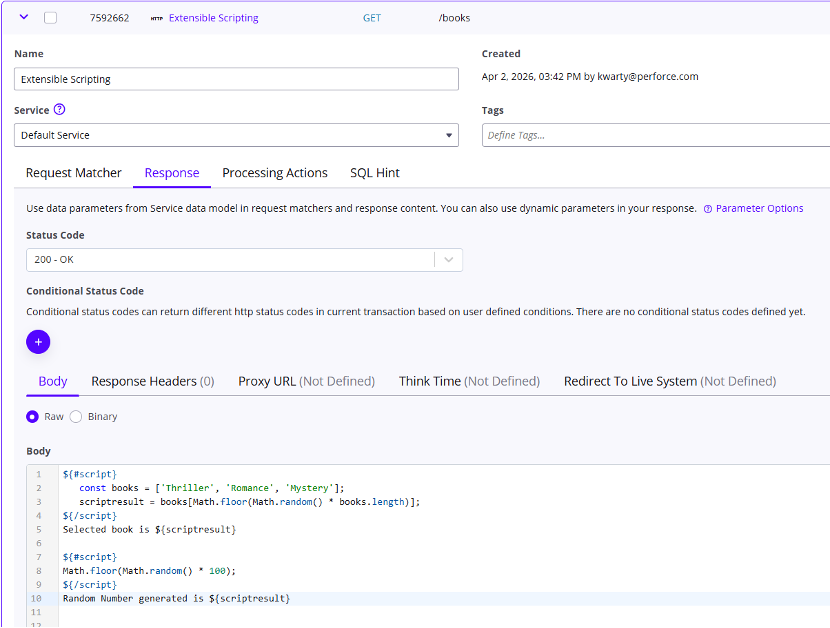
BlazeMeter Service Virtualization Extensible Scripts add a JavaScript-based scripting layer directly into virtual service execution. This gives teams a programmable way to support advanced business logic, request validation, conditional routing, dynamic data transformation, and response generation beyond what template-based rendering can provide.
Because this capability is built into the transaction flow, teams can introduce richer service behavior within the workflow they already use instead of relying on disconnected tools or more manual workarounds.
 Back to top
What Are Extensible Scripts and Why Do They Matter?
Extensible scripts allow teams to run inline JavaScript within the BlazeMeter service virtualization workflow, including across transactions, responses, and processing actions. That means service behavior can be shaped by logic at the point where the virtual service is being executed and not just by static templates.
In practice, this expands what teams can test. They can validate inputs more intelligently, transform payloads as needed, and simulate more realistic service behavior for both expected and unexpected scenarios.
Back to topKey Capabilities of Extensible Scripts
Advanced business logic simulation
Model service behavior that goes beyond fixed response templates by applying conditional and scenario-specific logic.
Request validation and conditional routing
Inspect incoming requests, validate data, and determine how the virtual service should respond based on the rules defined.
Dynamic data transformation
Adjust payloads during execution to reflect more realistic and variable service behavior.
Programmatic response generation
Generate responses dynamically to improve support for positive, negative, and edge-case testing.
Together, these capabilities make BlazeMeter service virtualization more flexible, more realistic, and better suited for complex application testing.
Back to topFrom Static Response Handling to More Realistic Service Simulation
Before extensible scripts, teams had less flexibility to represent variable logic and behavior within a virtual service. With scripting now built into the workflow, they can simulate a wider range of conditions and make virtual services more representative of real service interactions.
That shifts BlazeMeter Service Virtualization beyond basic static mocking and toward more realistic, rule-driven simulation. behavior that perfectly mirrors realistic API ecosystems. BlazeMeter Service Virtualization evolves from mock services to intelligent, programmable simulations.
Back to topReal-World Use Cases for Extensible Scripts
Simulate complex downstream dependencies
Create more realistic virtual versions of third-party or internal services when live systems are unavailable, incomplete, expensive, or difficult to coordinate.
Test business logic earlier
Validate request handling, service rules, and expected outcomes before dependent environments are fully ready.
Expand negative and exception-path coverage
Introduce delays, failures, invalid data, and unexpected outputs to test application resilience more thoroughly.
Strengthen broader continuous testing workflows
Bring more realistic service behavior into API, functional, and performance testing efforts to improve overall test fidelity.
Back to topWhy BlazeMeter’s Approach Stands Out
BlazeMeter brings a lightweight JavaScript-based scripting layer directly into the service virtualization workflow. That gives teams a practical way to extend behavior beyond template-based rendering without introducing separate frameworks or a more fragmented experience.
For teams that want more control over virtual service behavior without adding unnecessary complexity, that is a meaningful advantage.
Back to topHow Extensible Scripts Support Continuous Testing
Service virtualization is most valuable when it helps teams keep testing moving despite environment dependencies. Extensible scripts strengthen that role by making virtual services more realistic, more programmable, and more useful across API, functional, and performance testing workflows.
That supports earlier testing, broader coverage, and better alignment between test execution and delivery speed.
Back to topGetting Started With Extensible Scripts
You can find this new capability right inside your BlazeMeter asset catalog. The basic workflow involves three simple steps:
- Define your transaction.
- Add your response logic.
- Apply your script-based processing actions.
Starting small with validation or transformation use cases can help teams adopt the capability quickly before expanding into more advanced scenarios.
Back to topMake Service Virtualization More Flexible for Modern Testing Needs
BlazeMeter Service Virtualization Extensible Scripts help teams move beyond static response handling and simulate more complex service behavior directly within the workflow they already use. By embedding programmable logic into virtual service execution, teams can reduce dependency bottlenecks, test more realistic scenarios, and improve coverage earlier in the delivery cycle.
See how extensible scripts can help your team simulate more effectively and keep testing moving.